We get asked this a lot lately, usually halfway through a first walk-through, when someone has seen a giant glowing wall at a friend's house or a showroom and wonders if the projector they were planning on is already a relic.
The honest answer: projection isn't dead. But it's no longer the automatic choice for a big picture, and the reason is Micro LED. For years Micro LED was something we admired at trade shows and quietly steered people away from because the cost made no sense for a home. That's changing. It's becoming genuinely affordable for serious home projects, and it's changing the conversations we have about rooms.
The easiest way to explain why is to walk you through the kind of room where this comes up.
The room
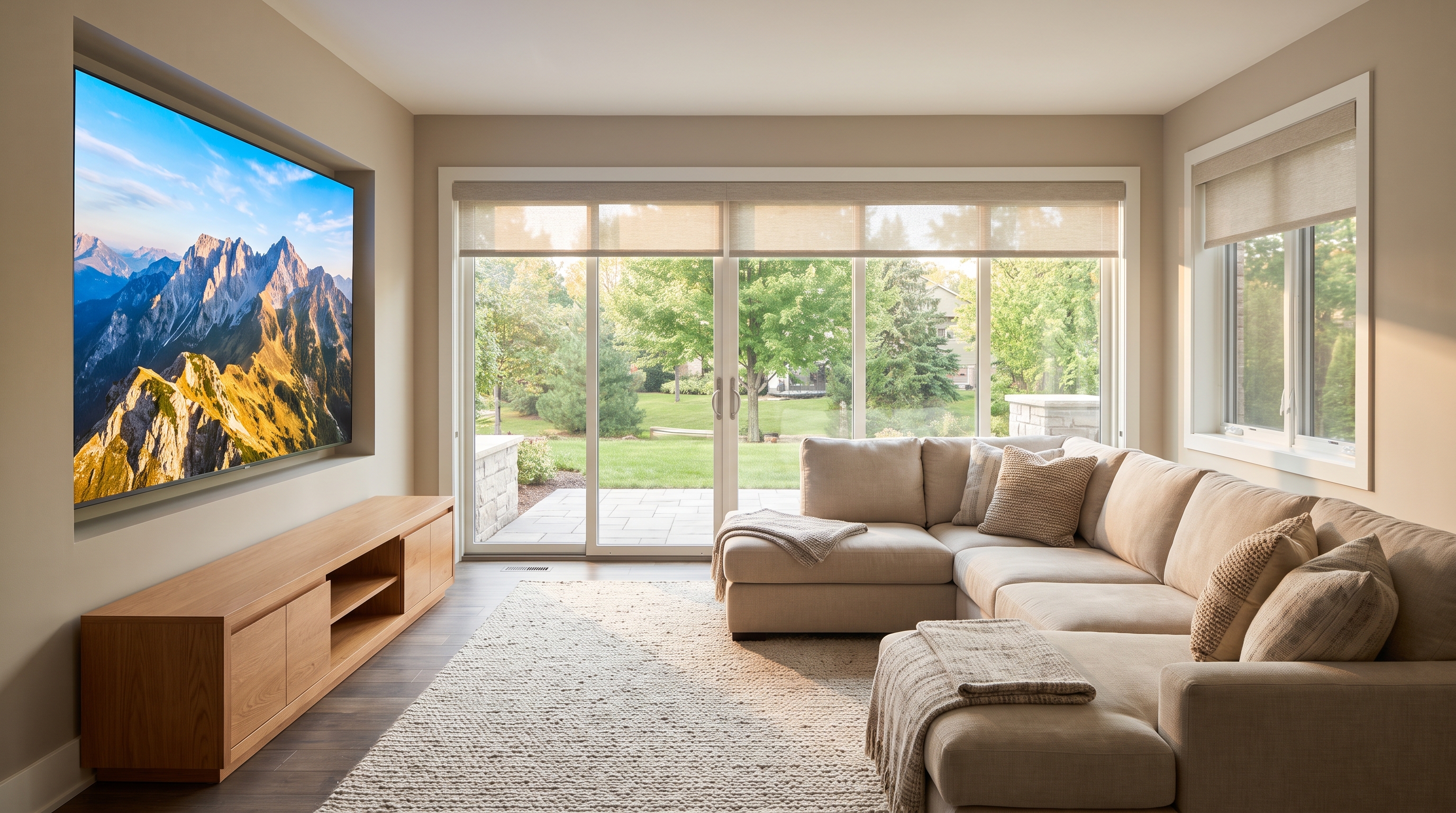
Picture a finished walkout basement in a newer home out in St. Charles County. It's a common layout around here: the back of the lower level opens to the yard through a wall of glass, with a sliding door and a couple of big windows. The family uses the space for everything. Saturday football with friends, kids' movie nights, game consoles, the occasional Sunday afternoon nap in front of golf.
They wanted big. Not "nice TV" big, but the kind of image that makes a room feel like an event. Their first instinct, and ours a few years ago, was a projector and a large screen.
The problem
Projection works by bouncing light off a screen. That's its charm and its weakness. In a dark, dedicated theater, a good projector on a well-chosen screen is beautiful and very cinematic. In a bright, multipurpose room, every bit of daylight lands on that same screen and washes out the blacks. The picture goes gray and flat right when the game is on.
This basement had everything working against a projector:
- Afternoon sun coming straight through the glass on the back wall
- Light-colored walls and ceiling bouncing that light around
- A family that wanted to watch at noon, not just at 9 p.m.
There are ways to fight this. Ambient light rejecting screens help a lot. Motorized shades help even more, and we install plenty of them. But this family didn't want to close the room up like a cave every time someone turned on the TV. The whole point of a walkout is the view.
Big flat panels were the other option, but even the largest consumer TVs top out well short of the size they were imagining, and the room called for something closer to a full wall.
What Micro LED actually is
Here's the quick version without the spec sheet.
A Micro LED display is made of tiny self-lit pixels. Each one makes its own light, so there's no backlight and nothing bouncing off a screen. Black is truly off. Bright is genuinely bright, bright enough to hold up against daylight in a way projection simply can't.
The displays are built from modular panels, often called cabinets, that fit together into one seamless image. That's why you can get sizes that used to be projector territory, and shapes that fit a specific wall rather than a standard TV dimension.
For years the catch was price. Building screens out of millions of tiny LEDs was expensive, and residential Micro LED sat at a level only a handful of projects could justify. That gap has narrowed meaningfully. It's still a real investment, and depending on size and resolution it can cost more than a high-end projection setup. But it's now a reasonable option to put on the table for the right room, rather than a fantasy.
What we did
For a room like this one, we'd design around a Micro LED wall sized to the seating distance instead of to the biggest number we could fit. Bigger isn't always better. You want the image to fill your vision comfortably from the couch without making you turn your head to follow the action.
The bigger design work is everything around the display:
- Structure and power. These panels are heavier than a screen and need proper mounting and dedicated electrical. In a basement that usually means coordinating with your builder or electrician early.
- Heat and ventilation. Micro LED gives off warmth. Our St. Louis summers are humid and basements can run cool and damp, so we plan airflow and make sure the equipment space breathes.
- Sound. You can't put speakers behind a Micro LED wall the way you can behind an acoustically transparent projection screen, so speaker placement gets planned around it from the start.
- Control. One remote or keypad that turns on the display, picks the source and sets the room, so nobody needs a manual on game day.
We'd still add shades on the glass, but as a choice for mood, not a requirement for a watchable picture.
How it feels now
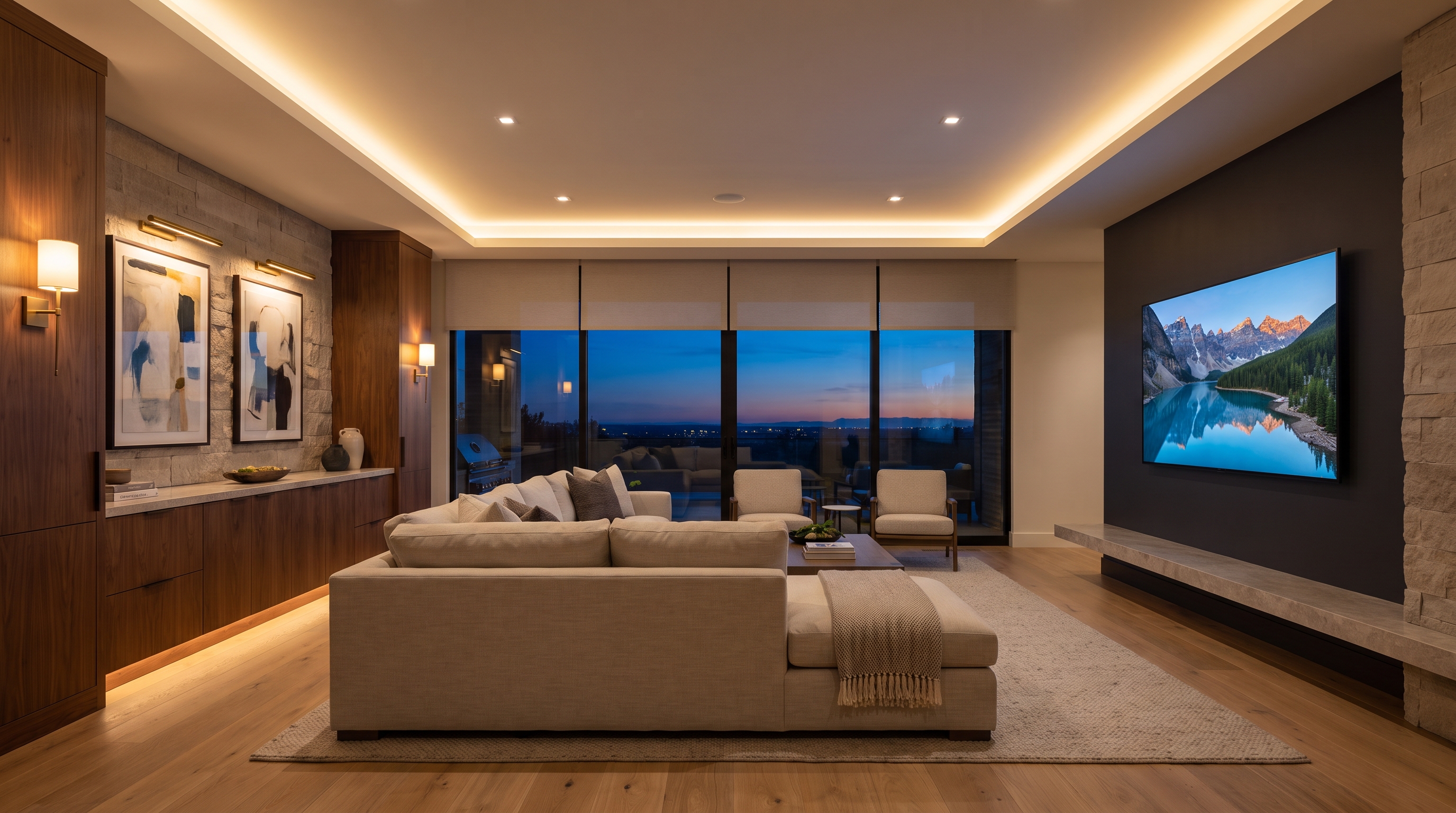
This is the part that matters. In a room like this, you walk downstairs at 2 p.m. with the sun pouring in and the picture is still rich and punchy. The game looks like the game. Kids' movies look like movies. Nobody is asking someone to close the blinds.
At night, with the lights down, it becomes a theater. Deep blacks, no glow from a projector fan, no beam to walk through when someone gets up for snacks.
The room gets used more, which is really the whole goal.
So when does projection still win?
Plenty of times, and we'd tell you so.
If you're building a dedicated, light-controlled theater with dark walls and no windows, a high-quality projector on the right screen is still a wonderful, cinematic experience. It can also be the more budget-friendly way to get a very large image. Some people simply love the softer, filmlike quality of projected light, and that's a fair reason to choose it.
Projection also makes sense for very large screens in rooms with limited wall structure, or where the screen needs to disappear, like a drop-down screen in a living room.
Here's roughly how we think about it:
- Dark, dedicated room and a focus on movies: projection is still a strong choice for a home cinema.
- Bright, multipurpose room used day and night: Micro LED is now worth a serious look, especially for a media room.
- Somewhere in between: this is where we sit down, look at the room, and compare honestly.
The real answer
Projection isn't dead. It just isn't the only way to get a huge picture anymore. Micro LED becoming affordable means the room gets to decide, not the technology's limits. A sunny walkout basement and a windowless theater under the stairs want different things, and now you can give each one what it needs.
If you're planning a new build or rethinking a basement or bonus room and you're not sure which way to go, we're happy to talk it through. Tell us a little about your space in our two-minute project questionnaire, and we'll come back with honest thoughts on what would actually feel best in your room.